
What would 20,000 versions of your development reveal?
A normal development appraisal gives you one central case. Our development risk model allows planning, construction cost, programme, funding and exit assumptions to move together and shows where the scheme may be most sensitive.
For SME ground-up developers, architects and professional teams.
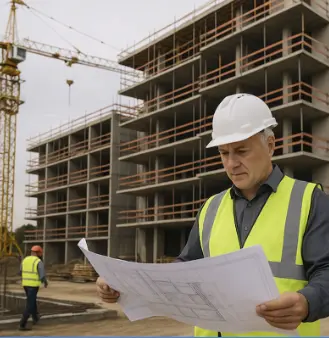
A development rarely moves one assumption at a time.
The conventional appraisal remains essential. It establishes land cost, build cost, GDV, programme, finance and expected profit.
The difficulty is that the scheme itself may not behave in the orderly way the central appraisal assumes. A planning issue can affect time and cost. A construction problem can do the same. Additional months affect interest and facility maturity. Market conditions can affect both realised value and the strength of a refinance exit.
The Ground-Up Development Risk Review is designed to see what happens when those risks are allowed to interact.
Where does the scheme deserve another look?
The value is not in producing another appraisal. It is in identifying which assumptions have the greatest potential to affect the scheme.
Planning
Where permission is not yet secured, how much of the downside is being driven by consent, conditions or planning delay?
Build & programme
What happens when a construction issue affects cost and time together rather than being treated as two unrelated sensitivities?
Funding
How much headroom remains if costs move, and how exposed is the development to running beyond the proposed facility term?
Exit
How dependent is sale or refinance on the central assumptions remaining broadly intact through to completion?
This is not a standard downside sensitivity.
The deeper model is built in R and produces a distribution of possible project outcomes rather than relying on one base case and a small number of manually selected stresses.
A warning is more useful before the project is fixed.
If the analysis highlights a particular sensitivity early enough, the response may be practical rather than financial.
Could the scheme itself change?
- Simplify part of the design
- Revisit build complexity
- Revise the programme
- Investigate a planning issue further
Does the commercial structure need more resilience?
- Increase contingency
- Make additional equity available
- Reconsider the proposed exit
- Review whether the margin is sufficient
Does the facility fit the project?
- Allow more funding headroom
- Use a longer facility term
- Review the funding structure
- Strengthen the proposed exit route
Development Risk Review
Your Ground-Up Development Risk Review
The deeper model produces a formal Development Risk Review designed to be discussed with the developer, architect and wider professional team.
It translates the modelling into the areas that may warrant further investigation rather than expecting the reader to work through mathematical notation.
Better assumptions produce a more useful review.
The Ground-Up Development Risk Review does not replace the professional team. Their judgement helps determine the assumptions that are tested.
Three stages, not another long process.
Build the assumptions
We start with the development appraisal, planning position, programme, proposed finance and intended exit.
Run the scheme
The model runs thousands of possible versions of the development, allowing the principal risks to interact.
Review the warnings
We identify where the scheme appears most sensitive and whether another look may be worthwhile.
A warning tool, not a forecast.
The model does not claim to predict whether a development will succeed. Its outputs depend on the assumptions entered, and those assumptions can be challenged and changed.
Its purpose is to identify sensitivities, concentrations of risk and possible pressure points which may deserve further investigation. It is intended to sit alongside proper professional diligence, not replace it.
What would 20,000 versions of your development tell you?
You already know the central appraisal. The more interesting question may be what happens when planning, cost, programme, funding and exit are allowed to move around it.
For SME ground-up and major redevelopment schemes.